
Visual Management - Process Control Boards
Showing the single result
-
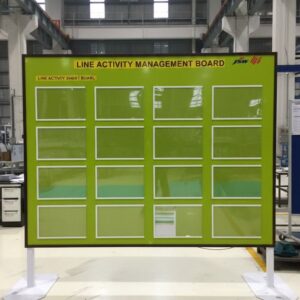 Visual Management - Process Control Boards
Acrylic Folder Display
Introduction
In industries, safety communication is not just about displaying information—it’s about how clearly and consistently it is displayed. Visual and structural symmetry solutions help standardize workplace layouts, making it easier for employees, contractors, and visitors to understand safety zones, navigate efficiently, and maintain compliance.
Globelite provides visual and structural symmetry boards and solutions that improve workplace organization, hazard communication, and process visibility. These boards are widely used in factories, warehouses, hospitals, schools, and commercial spaces to create uniformity and reduce confusion.
What Is Visual and Structural Symmetry?
- Definition: A system of boards and markings designed to maintain uniformity and balance in workplace layouts, ensuring that safety and information cues are consistent throughout the facility.
- Purpose: Simplify communication, minimize errors, and create environments where employees can easily understand their responsibilities and surroundings.
- Examples:
- Standardized signage across departments.
- Symmetrical visual boards in production lines.
- Balanced layouts of safety posters and hazard warnings.
Importance of Visual and Structural Symmetry in Safety
- Improves Communication – Uniform boards and layouts reduce misinterpretation.
- Boosts Efficiency – Workers quickly recognize safety instructions and process steps.
- Supports Compliance – Aligns with ISO/OSHA safety requirements.
- Enhances Workplace Culture – A well-organized environment reflects professionalism.
- Reduces Human Error – Consistency ensures employees don’t miss critical safety information.
📌 Example: A logistics company improved warehouse navigation and reduced forklift-pedestrian conflicts by installing symmetrical visual markers and consistent sign boards throughout the site.
Applications of Visual and Structural Symmetry Boards
Industrial Workplaces
- Production floor layouts with consistent signage.
- Machine zones marked with identical hazard boards.
- Color-coded instructions for PPE and emergency procedures.
Warehouses & Logistics
- Symmetrical sign placements for loading bays and aisles.
- Visual guidance for pallet stacking and equipment parking.
Hospitals & Schools
- Symmetrical signage for exits, labs, and restricted areas.
- Visual balance for safety reminders in hallways and wards.
Corporate Offices & Commercial Spaces
- Standardized fire safety boards across floors.
- Consistent visual instructions in stairwells and common areas.
Benefits of Visual and Structural Symmetry
- Clarity: Employees always know what to expect.
- Uniformity: Creates a clean and professional appearance.
- Improved Safety: Reduces risk of accidents by eliminating confusion.
- Training Aid: New employees adapt faster when visuals are consistent.
- Audit-Ready: Consistency simplifies compliance checks.
Materials & Design Features
- ACP (Aluminum Composite Panels): Long-lasting, ideal for indoor/outdoor.
- PVC / Acrylic Boards: Affordable and clean finish for indoor use.
- Reflective Options: Improve visibility in low-light conditions.
- Photoluminescent Options: Maintain visibility during blackouts.
- Customization: Add company logo, SOP QR codes, or bilingual text.
Best Practices for Implementation
- Use consistent colors and icons across the facility.
- Position boards at eye level (1.5–1.8 m).
- Maintain uniform spacing for a balanced look.
- Replace worn or outdated boards to preserve symmetry.
- Align with international standards (ISO 7010 pictograms, OSHA formats).
Buying Guide – Choosing Visual & Structural Symmetry Boards
- Identify zones: Production, logistics, emergency exits, visitor areas.
- Select materials: ACP/Reflective for outdoor; PVC/Acrylic for indoor.
- Design consistency: Keep fonts, icons, and layouts the same.
- Size selection: A3/A2 indoors; A1/custom for large areas.
- Language: Use bilingual text for mixed-language workplaces.
Comparison – Symmetrical vs Non-Symmetrical Signage
| Attribute | Symmetrical (Standardized) | Non-Symmetrical (Random) |
|---|---|---|
| Visual appeal | High | Low |
| Ease of understanding | Easy & fast recognition | Confusing & inconsistent |
| Safety compliance | Strong | Weak |
| Training support | Faster | Slower |
Maintenance Tips
- Quarterly inspection: Check alignment, fading, and consistency.
- Cleaning: Regular wipe-downs to keep colors vibrant.
- Replacement cycle: Every 3–5 years or after layout changes.
- Audit checks: Ensure symmetry is maintained during expansions.
FAQs – Visual & Structural Symmetry
- What are visual and structural symmetry boards?
Boards designed to maintain consistent safety communication across facilities. - Why is symmetry important in safety signage?
It improves clarity, reduces errors, and creates a professional workplace. - Can these boards be customized?
Yes—logos, bilingual text, QR codes, and custom layouts are possible. - What materials are recommended?
ACP for long life, PVC for indoor use, reflective/glow for visibility. - Do they help in audits?
Yes, standardized boards simplify ISO/OSHA audit compliance. - Where should symmetry boards be placed?
At entry points, production areas, corridors, stairwells, and common zones. - How often should they be updated?
Every few years, or whenever new hazards/process changes occur.
Conclusion
Visual and structural symmetry boards are not just about aesthetics—they are vital tools for safety communication, operational efficiency, and compliance. By standardizing layouts and maintaining balance in signage, organizations ensure employees and visitors always know what to do, where to go, and how to stay safe.
Globelite offers customizable, durable, and compliant boards that help organizations achieve consistency and build a strong safety culture.